Showing posts with label controversy. Show all posts
Showing posts with label controversy. Show all posts
Tuesday, 12 June 2012
The 40th anniversary of the Watergate scandal
<script src="http://player.ooyala.com/player.js?deepLinkEmbedCode=JsZzlvNDrJsrBByv0rDWDOdvn039RgKd&width=606&height=341&embedCode=JsZzlvNDrJsrBByv0rDWDOdvn039RgKd&video_pcode=BjMW06iecUOEhEKw8wym0AKLeiI4"></script>


Tuesday, 31 January 2012
Democrats Beaten Back by the Waves of History: Is Rapprochement with Iran a Possibility?
 |
| Outside the American embassy after a mission to rescue hostages failed |
 |
| Burning an effigy of Uncle Sam outside U.S. embassy in Tehran |
Decades of interference, both overt and covert, had convinced the west that any kind of uprising to get rid of the Shah did not exist, even within the realms of possibility. Opposition to the Shah's rule within Iran was dismissed by the CIA in a report which stated only months beforehand that Persia 'was not even in a pre-revolutionary situation'. In his New Year's Eve toast in 1978 President Carter issued the immortal words, 'under the Shah's brilliant leadership Iran is an island of stability.'
 |
| An American flag set on fire by Iranian protesters |
The Reagan administration was plagued (at least in its second term), by the possibility of the public finding out about a number of arms for hostages deals. Lieutenant Colonel Oliver North of the staff of the National Security Council gave the go-ahead to take twelve million dollars from arm sales to Iran, and give the money to the contra 'freedom' fighters in Nicaragua. This was pointedly against all protestations from Reagan that he absolutely and categorically refused to negotiate with terrorists and that any arms for hostages deal was out of the question. [1]. An ongoing scandal for the Republicans with a Democrat congress to contend with, the exact role of President Reagan in the scandal was never properly delineated, and will probably never be known.
 |
| One of many spontaneous mass demonstrations against the Shah |
With a regime change in 1992, President Bill Clinton appealed to many as a progressive who would perhaps reach out to Iran in a show of friendship (with of course the necessary conditions.) As with most centre-left parties in western democracies, the Democrats had to worry about managing to stay in power, once they were elected. They had to tread carefully with the voters in order not to seem indifferent to matters of national security. They had to appear resourceful, and able to take the initiative when it came to protecting the country's interests abroad. Yet the bellicosity of the Republicans did not seem to work for them. They had to forge an image which enhanced their ability at making the peace, at reaching out and achieving some kind of dialogue with nations whose customs and religious beliefs were less comprehensible to them than others, in an area of the world as important economically as it was politically.
 |
| Reagan receiving the Tower Commission report c1987 |
With a Democrat President currently in office, the rhetoric of the hawks with their itchy trigger fingers is balanced by a more prudent and rational discourse, as the United States attempts to balance national security pre-occupations with its international responsibilities and its revisionist stance to right the wrongs of the disreputable regime that came before the current administration. Neither political party has had much success in breaking through the institutionalised antipathy that America and Iran feel for each other. But that isn't to say that it won't happen, and in the process save the world from a confrontation that may be too dreadful to contemplate.
[1] Bob Woodward, Shadow: Five Presidents and the Legacy of Watergate, New York, Simon & Schuster, 1999, Ch. 10, p. 110.
Saturday, 24 September 2011
Some Thoughts About Capital Punishment
The moral cost of violent crime in our society is not an issue most of us like to dwell upon. It's something whose implications are so vast, they beggar the imagination. Have we become for instance, far too libertarian in our tolerance of what constitutes criminal behaviour? Or have we instead, become too religious, quoting the New Testament to illustrate the the life and teachings of Jesus Christ, which leaves us trapped in a strait-jacket of sanctimony? Or are we becoming more blood thirsty, still plotting for revenge when we think we've been wronged, and how does this satisfy our desire for justice, when revenge is (supposedly) nothing more than a primitive urge going back to the Dark Ages? None of this sits easily with the image we have of ourselves as brain centred humans who do not let our emotions rule our decisions -- when in fact that is exactly what does happen, in defiance of our rationalisations to the contrary.
It seems to be that the nuts and bolts of a particular crime, or the crimes of a particular criminal, is what keeps the justice system chugging along. I can't say that has ever interested me. I was going to write a post for this blog about the Shark Arm murder case, one the most famous murder cases in Australian history. But just regurgitating the whats and wherefores of the story because I didn't know enough about it to say anything original, was boring to me so I decided to abandon the idea. God knows I've read enough about it now to take some kind of diploma about the subject. The problem was, I just didn't know what I could say about it that hasn't been said a thousand times before.
I'm leading up to something and I think that it's to do with what's been recently happening in the States. A possibly innocent man by the name of Troy Davis was executed in Georgia, and there was a lot of news about it. Many people protested and despite a stay of execution, the Supreme Court ordered Georgia to go ahead with the execution. I didn't know enough about the case to make much comment but my heart went out to the family of the victim, as well to as the family of Mr Davis. We all know of the figures which tell us the likelihood of African Americans becoming trapped in the web of the American criminal justice system, and I would be nothing more than an insensitive (white) fool to dispute them. But to me, the issue of capital punishment cuts across all racial boundaries.
As far as I am concerned, the practice of capital punishment is nothing more than state-sanctioned murder, and to take a principled stand on the issue of capital punishment means that the guilt or innocence of the person sentenced to death is irrelevant. Since sentencing someone to die is a legal aberration, the relevance of the guilt or innocence of the person will be a matter for the courts and the defence lawyers who advise the person of their legal rights. Like British transportation to New South Wales in the nineteenth century (which was a sentence of death commuted to life imprisonment to the Australian penal colony for the term of one's natural life), capital punishment is an irrational form of revenge used more as a means of social control and less as a deterrent for the lower classes it was once thought were more prone to violent crime and anti-social behaviour.
Personally, I think that if people keep up the struggle, and protest loudly and vehemently enough for the powers-that-be to take notice, capital punishment will become too unpopular, and thus a thing of the past. If you believe in progress, then the only direction we have is ahead. We'll be living in a time when we can look back and blame our precursors for visiting this wretched stain upon our social fabric, and praising ourselves on our intelligence and bravery for having done away with it altogether.
It seems to be that the nuts and bolts of a particular crime, or the crimes of a particular criminal, is what keeps the justice system chugging along. I can't say that has ever interested me. I was going to write a post for this blog about the Shark Arm murder case, one the most famous murder cases in Australian history. But just regurgitating the whats and wherefores of the story because I didn't know enough about it to say anything original, was boring to me so I decided to abandon the idea. God knows I've read enough about it now to take some kind of diploma about the subject. The problem was, I just didn't know what I could say about it that hasn't been said a thousand times before.
I'm leading up to something and I think that it's to do with what's been recently happening in the States. A possibly innocent man by the name of Troy Davis was executed in Georgia, and there was a lot of news about it. Many people protested and despite a stay of execution, the Supreme Court ordered Georgia to go ahead with the execution. I didn't know enough about the case to make much comment but my heart went out to the family of the victim, as well to as the family of Mr Davis. We all know of the figures which tell us the likelihood of African Americans becoming trapped in the web of the American criminal justice system, and I would be nothing more than an insensitive (white) fool to dispute them. But to me, the issue of capital punishment cuts across all racial boundaries.
As far as I am concerned, the practice of capital punishment is nothing more than state-sanctioned murder, and to take a principled stand on the issue of capital punishment means that the guilt or innocence of the person sentenced to death is irrelevant. Since sentencing someone to die is a legal aberration, the relevance of the guilt or innocence of the person will be a matter for the courts and the defence lawyers who advise the person of their legal rights. Like British transportation to New South Wales in the nineteenth century (which was a sentence of death commuted to life imprisonment to the Australian penal colony for the term of one's natural life), capital punishment is an irrational form of revenge used more as a means of social control and less as a deterrent for the lower classes it was once thought were more prone to violent crime and anti-social behaviour.
Personally, I think that if people keep up the struggle, and protest loudly and vehemently enough for the powers-that-be to take notice, capital punishment will become too unpopular, and thus a thing of the past. If you believe in progress, then the only direction we have is ahead. We'll be living in a time when we can look back and blame our precursors for visiting this wretched stain upon our social fabric, and praising ourselves on our intelligence and bravery for having done away with it altogether.
Sunday, 11 September 2011
Where Were They?

These Weapons of Mass Destruction cannot be displayed
The weapons you are looking for are currently unavailable. The country might be experiencing technical difficulties, or you may need to adjust your weapons inspectors mandate.
Please try the following:
Click the
 Regime change button, or try again later.
 If you are George Bush and typed the country's name in the address bar, make sure that it is spelled correctly. (IRAQ).
To check your weapons inspector settings, click the UNmenu, and then click Weapons Inspector Options. On the Security Council tab, click Consensus. The settings should match those provided by your government or NATO.
If the Security Council has enabled it, The United States of America can examine your country and automatically discover Weapons of Mass Destruction.
If you would like to use the CIA to try and discover them,
click
 Detect weapons
 Some countries require 128 thousand troops to liberate them. Click the Panic menu and then click About US foreign policy to determine what regime they will install.
If you are an Old European Country trying to protect your interests, make sure your options are left wide open as long as possible. Click the Tools menu, and then click onLeague of Nations. On the Advanced tab, scroll to the Head in the Sand section and check settings for your exports to Iraq.
Click the
 Bomb button if you are Donald Rumsfeld.
 Cannot find weapons or CIA Error
Iraqi Explorer
Wednesday, 31 August 2011
How European Philosophers Had a Dust-Up over the Great Lisbon Earthquake of 1755
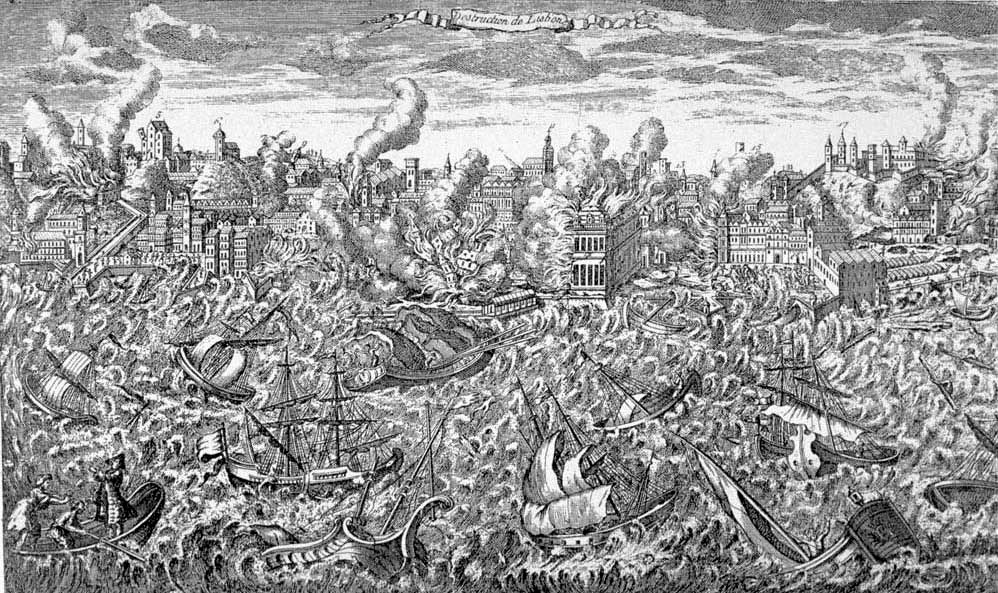 |
| A study of the tsunami and earthquake at Lisbon 1755 |
Apart from the shocking loss of life, and devastation, the earthquake also had a number of unforeseen consequences. These included such diverse developments as the virtual birth of seismology as the science of predicting earthquakes, as well as a stay of Portugal's efforts to be seen as as a great colonial and naval power. Perhaps the most provocative consequence of such an obviously world-shattering event was that it initiated a dialogue between the great philosophers of the period, who attempted to hijack any explanation of the earthquake away from the teachings of the Roman Catholic church and toward a discussion of the new Enlightenment way of thinking. In the later twentieth century, the Lisbon earthquake has been compared to the Jewish Holocaust, in its power to transform the culture and philosophy of Europe because of the destruction it caused, and the terrible human suffering that was its consequence. After all, this was still a period in European history that condoned such things as the burning of witches, bleeding people with leeches when they were sick, as well as the refutation of anything that disagreed with the Aristotelian view that the sun revolved around the earth, two hundred years after Galileo had made his discoveries to the contrary.
What followed was a remarkable discourse between members of the European intelligensia which openly mocked the teachings of the church in order to educate the common people on the powers of the new concept of reason as a method for them to improve their lot, removing the shackles of superstition from an ignorant landed peasantry, and enabling them to question the subservience they were expected to observe to a higher deity. The earthquake had ironically struck on the Catholic holiday of All Saints Day. Virtually every important church in the city had been destroyed and theologians rushed to explain the catastrophe away as the divine judgment of God, much to the chagrin of the survivors who had lost their loved ones, whilst the King of Portugal and his family had been spared after taking their leave of the city for a holiday the night before the quake occurred.
The great enlightenment French philosopher Voltaire took the opportunity to attack the prevailing philosophical thought of the epoch which was described by Leibniz as 'all's for the best in the best of all possible worlds' by writing the poem 'The Disaster of Lisbon' : "Come ye philosophers, who cry, all's well/ and contemplate this ruin of a world." In Candide the Optimist, Voltaire has Candide, the eternal optimist exclaim: "if this is the best of all possible worlds, what are then the others". In 1757 Samuel Johnson gathered to the fray and defended Voltaire's more realistic response by disparaging fellow Englishman Alexander Pope's insistence that things would somehow be put to right by stating "Pope thus never saw the miseries which he imagines thus easy to be borne." Optimism, Voltaire declares, "is merely an insult to the miseries of our existence" and only the churchmen whose churches were destroyed are foolish enough to believe that evil does not, at least sometimes, prevail over good. In 1756 Rousseau scolded Voltaire in a letter that complained that taking away religion reduces the human race to a despair far worse that it would suffer without it, but it seems that Voltaire had the ear of the people and perhaps offered them more solace than any of the churchmen ever managed.
 |
| A tent city was built. Looters were hung as an example by King Joseph I |
The city of Lisbon, once the most beautiful in all of Europe, was eventually rebuilt, but the earthquake which destroyed it, also destroyed the confidence and equilibrium of a Europe which pictured itself as the most important power in the world. Lands in America were being conquered, trading routes were opening up and the future looked bright for the bourgeoisie, the merchants and the conquistadors. Rumours spread about how the disaster was an omen from God, or a way of punishing the King of Portugal for his wickedness in mistreating the indigenous south American Indians. This is of course only superstition, for as Werner Hamacher has stated, it was the foundational certainty of Descartian philosophy that began to shake after the Lisbon earthquake.
Works consulted: the full text of the Disaster of Lisbon here; relevant Wikipedia article here; Lisbon earthquake here; Historical depictions of the 1755 Lisbon earthquake here; Lisbon pre-1755 Lisbon earthquake here; and link to popular history work best known at the moment here.
Tuesday, 23 August 2011
What other unsolved crime is gaining newly discovered suspects over 100 years AFTER it was committed? Look no further than Jack the Ripper

Ripperologists, as they are known today, are people who specialise in research concerning the crimes of Jack the Ripper. Ripperologists are thought to be a bit strange. With all that’s going on in the world, why are they obsessed by something that happened 100 years ago, something so heinous, it seems to fever our imaginations from one generation to the next? If you’d asked me only recently, if I’d be commenting online about the state of on-going Ripper studies, I would have either laughed at you, or taken an Alka-Seltzer for my upset stomach. But here I am, in my foolish efforts to prove myself, having read a book (tellingly looked down upon by most Ripperologists) called ‘The Fox and Flies: The Criminal Empire of the Whitechapel Murderer’. It makes a case for a suspect in the Jack the Ripper serial killings that no one has ever heard of outside the musty reference rooms of old universities and police files considered lost to posterity by pilferage or just plain disinterest. The suspect’s name is Joseph Silver, (pictured above) he was a Polish Jew, and probably something far more serious than a ‘petty ’criminal: he sounds in fact, like a criminal mastermind. The author of the book, South African historian Charles van Onselen specialises in criminal history, and for the first time dips his toe into the cold water of ‘Ripperology’. He makes a good fist of it, but unfortunately any substantial proof of Silver being in Whitechapel at the time of the murders is a tad on the flimsy side. He did father an illegitimate child to an unknown woman in April 1888, whilst living in London but as far as being Jack the Ripper is concerned, there just doesn’t seem to be the necessary evidence. Whilst erring on the side of social history and being self-effacing enough to admit that psychiatric observations are not up his alley, van Onselen’s style is an endearing mixture of erudition, solid research and a confidential just-you-me-and-the-gatepost-know-about-this familiarity with his readers. (And I would contend that his psychiatric observations are actually quite acute and very useful.)
As a beginner in Ripperology I have learned that there are what is known as a ‘canonical five’ victims of Jack the Ripper, that is five women who were most likely than not, murdered by the same man by the same method. The canonical women are in order of their demise: Mary Nicholls, Anna Chapman, Elizabeth Stride Catherine Eddowes, and Mary Jane Kelly. Where Onselen’s book is concerned, one of the most pertinent issues was for me, the case of the last victim, Mary Jane Kelly. Using information gleaned from secondary sources, van Oselen puts together a narrative which alerts the reader to the fact that Mary Jane Kelly may have been acquainted with her assailant. If this is so, this raises the question of the identity of a man who was believed to be Mary Jane’s secret lover whose name was Joe, as in Joseph Barnett, her live-in companion, and Joseph Flemming her ex-partner, both temporary suspects in the murder but eventually cleared by police investigation. If Mary Jane had known her attacker, she was in fact, following the story of the murders in the newspapers and penny dreadfuls and was fearful of her life for good reason.
As far as the suspects are concerned, there also appear to be a ‘canonical’ number as set down by the Macnaghten Memoranda of 1894 which has influenced research into the case for the past forty years. The canonical suspects are MJ Druitt, George Chapman, Aaron Kosminski, and Michael Ostrog. To be frank, they are not terribly impressive. Druitt committed suicide, Chapman was a wife poisoner, and Kosminski and Ostrog were institutionalised and do not appear to have the violent pathological backgrounds for someone as brutal as the Ripper. A book on the primacy of Kosminski as a suspect has recently been published, Jack the Ripper and the Case for Scotland Yard's Prime Suspect by Robert House. It seems like an interesting contribution to the discussion as it increases the credibility of a suspect previously dismissed as having a profile incapable of committing the Ripper’s atrocities. As well there are a number of suspects who could rightfully be described as outlandish, including Lewis Carroll, the Duke of Clarence and William Gladstone a former Prime Minister of Britain who showed a concern for the plight of prostitutes to the extent that he was considered in a dubious light and perhaps was not to be trusted.
To give an example of what I have noticed is the peripatetic nature of Ripperology, I could make the assertion that the identity of Jack the Ripper may never be known. This would not be such an unsubstantiated claim, if it weren’t for a story posted on the web only a few months ago in May of this year. It tells of a so-called conspiracy by Scotland Yard to keep documents created contemporaneously, still the secret they have always been since the first police investigation into the incident in London in 1888; these documents may reveal that Scotland Yard always knew the identity of the perpetrator but never had enough evidence to prove it in court. Trevor Marriott, a Ripper investigator and former detective, has spent three years attempting to obtain uncensored versions of the documents which have been kept from the public and could reveal Jack the Ripper’s true identity. A separate discussion is also emerging into the case concerning the extent of anti-Semitism in the East End at the time that the murders were committed insofar as Scotland Yard was constrained in revealing the identity of the killer. They were afraid it would set off reprisals against the Jewish population who had settled in East London to escape from the pogroms of Russia and Poland but were completely innocent of any wrongdoing. Jack the Ripper it seems is alive and well in our imaginations, as we attempt to make sense of many strands of seemingly inconsequential information, weaving them into a whole as we blunder along assuming that we can solve a mystery that probably will never have a solution
Removed from the personalities of the piece, members of the constabulary who had their careers on the line, and celebrity suspects who could never possibly have done it, what we have left are the anonymous mass of people, in the words of Edmund Burke, the ‘swinish multitudes’. They were born in squalor, lived with poverty and disease and were left to die lonely deaths, their lives cut short by indifference and neglect. These are the people that for better or worse are preyed upon In this world, and the predators who prey upon them, will have to answer to their own God. As for the rest of us, we have our imagination, but it plays tricks on us. It makes us believe that we are somehow different, and protected from the predations of existence. But what is waiting for us around the corner is no different for us, than the people of the East end of London whose faces in old photographs look out at us and in doing so, remind us of ourselves.
Subscribe to:
Posts (Atom)